In 1975, three psychiatrists published a 30-point bedside test that any clinician could give in about 10 minutes [1]. Half a century later, the Mini-Mental State Examination (MMSE) is still in use, and dozens of other tools have joined it. Why so many? Because successive generations of cognitive assessment tools have sought to address different clinical needs, including administration time, sensitivity to subtle impairment, accessibility, and consistency of measurement.
This article follows that chain of fixes through four generations: standardized bedside tests, brief primary care screeners, screeners built to catch mild impairment, and digital multi-domain platforms, and the challenges that continue to exist even in the digital multi-domain generation.
Key takeaways
- Most screening tools were built around a workflow limit, such as visit length or staff skill. Several were also built around patient factors such as education, language, or vision.
- The MMSE standardized the bedside exam, and the Mini-Cog shortened it to fit a primary care visit. The MoCA added sensitivity to mild cognitive impairment, or MCI.
- Paper-based tools still depend on who gives and scores them, which makes it hard to tell real change from noise across visits.
- Digital multi-domain assessment targets the consistency gap with standardized, automatically scored, repeatable measures.
- A platform needs more than one mode of administration to reach patients where they are, with every result captured digitally, scored automatically, and tracked longitudinally.
- Digital multi-domain assessment narrowed the consistency gap, and screening is still only the first step in cognitive care. The work that follows a positive result, from interpreting it to monitoring change, has no easy place in a busy primary care visit, and the neurology referral queue adds to the strain.
The Timeline
Before the MMSE: bedside judgment and single tasks
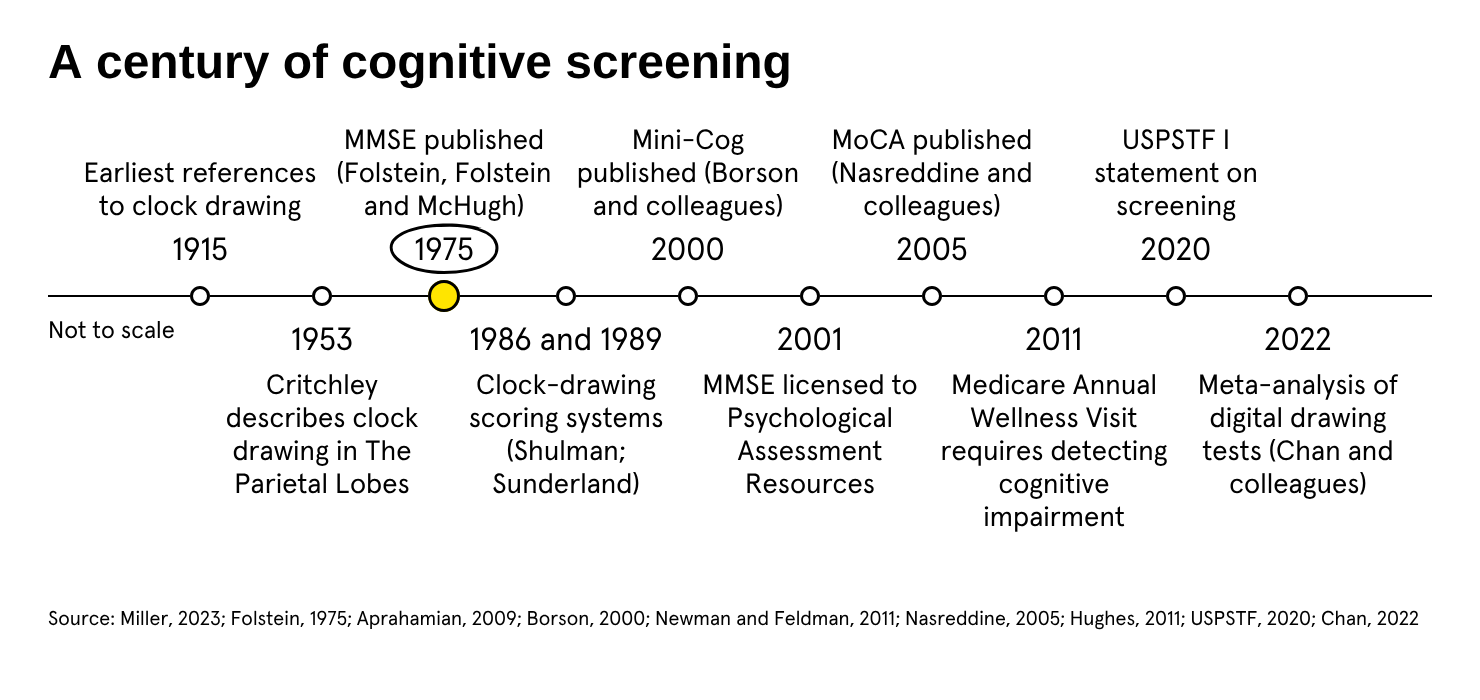
Prior to 1975, clinicians judged cognitive status through things like unstructured interviews and single tasks. Drawing a clock is known as one of the oldest, with references to clock-drawing dating back to 1915. Macdonald Critchley's 1953 book The Parietal Lobes is often cited as its first formal description [2]. Neurologists used it originally to look for constructional apraxia, which is the difficulty with assembling parts into a whole, after injury to the parietal lobes.
This approach depended on the clinician. At this time, there were no standard questions or scoring with a repeatable process to follow. One clinician's judgment could not be compared equally with another's, or with the same clinician's judgment a year later. It lacked a longitudinal evaluation model.
1975: The MMSE standardizes the bedside exam
Marshal Folstein, Susan Folstein, and Paul McHugh published the Mini-Mental State Examination in 1975 in the Journal of Psychiatric Research. It scores 30 points across orientation, registration, attention and calculation, recall, and language, and takes about 10 minutes [1].
It provided every clinician with the same questions and the same score. This meant a score from one clinic could be read and compared in another, leading to the MMSE becoming the reference test in research and practice for decades.
Even with this improvement, the test has two remaining weaknesses: it includes few items for executive function, and it is weak at detecting mild impairment. In the 2005 study that introduced the Montreal Cognitive Assessment (MoCA), the MMSE detected 18% of people with mild cognitive impairment (MCI), compared with 90% for the MoCA, with both tests scored at a cutoff of 26 [3].
The MMSE was originally free to use, and its copyright went largely unenforced for about 25 years after publication. In March 2001, the rights were licensed exclusively to Psychological Assessment Resources (PAR), and clinicians were asked to pay roughly $1 or more per test [4, 5]. Free alternatives such as the MoCA were available to practices that preferred to avoid the fee [4].
1986 to 1989: The clock-drawing test gets scoring systems
The clock task moved from a neurologist's impression to a scored screen when Shulman published a scoring system in 1986, and Sunderland followed in 1989, with Mendez and Tuokko adding systems in 1992 [6].
Miller's Psychiatric Times review notes that more than a dozen systems now exist, with similar psychometric properties and mean sensitivity and specificity of about 85% for dementia [2]. Its limit is sensitivity in mild impairment and early dementia, where it misses more cases.
2000: The Mini-Cog makes screening fit a primary care visit
Soo Borson and colleagues published the Mini-Cog in 2000 as a brief screen built to work across language and education levels [7]. It combines three-word recall with a clock drawing and took about 3 minutes in the original study, compared with 7 minutes for the MMSE, which allows it to fit into a busy primary care visit (see our guide to Top 10 Cognitive Screening and Assessment Tools). Fit for patients of varied language and education was a central design goal, with the time savings alongside it. Although the Mini-Cog offers practical advantages in primary care, its performance in identifying MCI is less established than its performance in detecting dementia, and accuracy varies by population and clinical setting [2]. Across very brief screening tools, the USPSTF review reported sensitivity for detecting dementia ranging from 0.43 to 1.0, and accuracy was generally higher for dementia than for MCI [10].
2005: The MoCA targets mild cognitive impairment
Ziad Nasreddine and colleagues published the Montreal Cognitive Assessment in 2005 to catch the mild impairment the MMSE missed. Like the MMSE, it scores 30 points and takes about 10 minutes. Unlike the MMSE, it includes visuospatial and executive function items, naming, and abstraction. Scores below 26 suggest impairment, and one point is added for people with 12 years of education or fewer.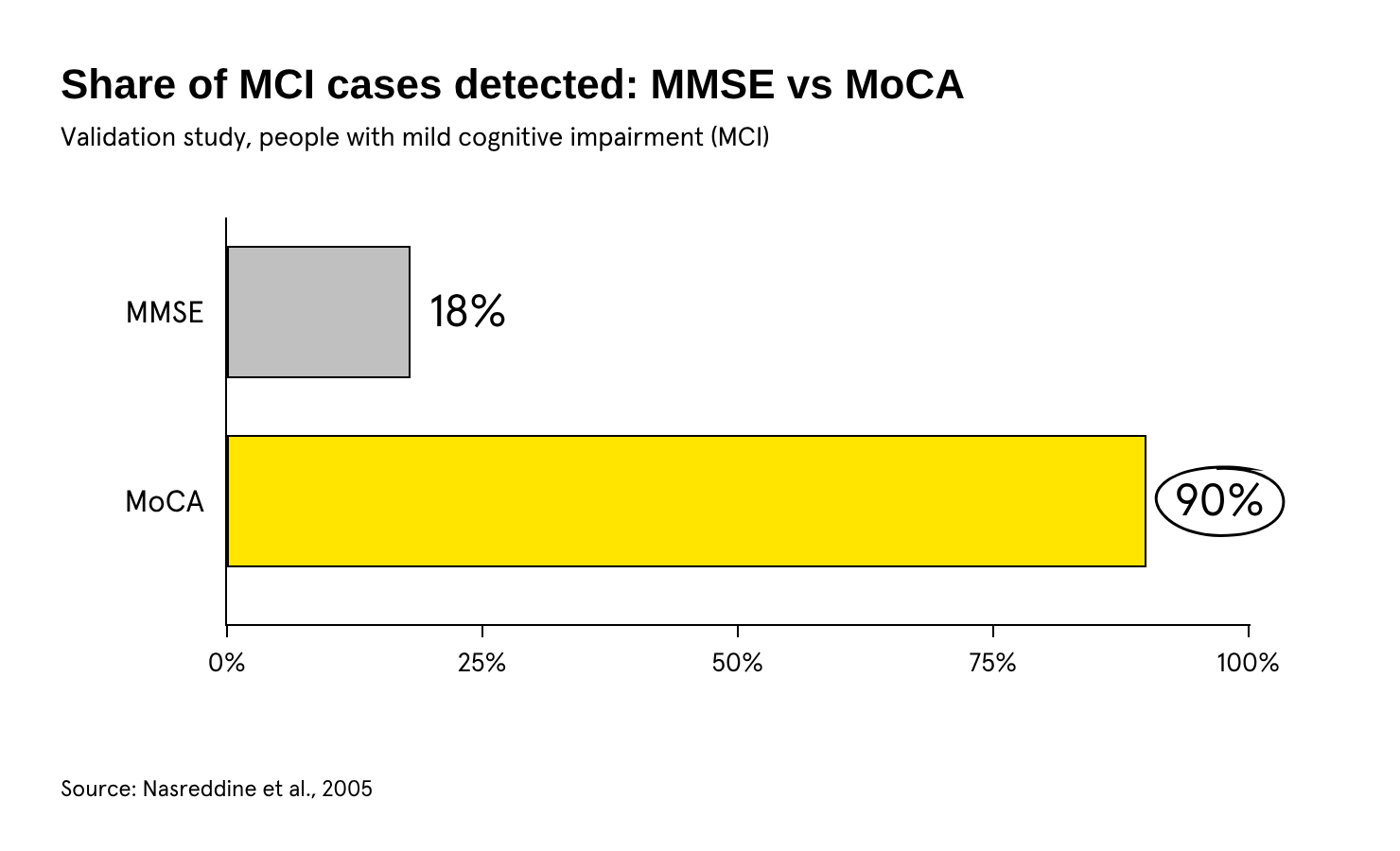
The chart shows the gap in MCI. In the same study, the MoCA also detected 100% of mild Alzheimer's disease cases, compared with 78% for the MMSE.
What it solved for was sensitivity to early change. However, it left dependence on the person administering it: a trained administrator still reads the instructions, times the tasks, and scores the drawings. The result is only as comparable as the administration behind it.
2011 to 2020: Policy makes screening routine, then questions the tools
The Medicare Annual Wellness Visit became available on 1 January 2011, and "detection of any cognitive impairment" is one of its required elements [8]. CMS later added CPT code 99483 for a separate cognitive assessment and care plan visit of about 60 minutes [9]. The Medicare Annual Wellness Visit helped establish cognitive impairment detection as a routine component of preventive care for Medicare beneficiaries. However, CMS does not require a specific standardized cognitive screening instrument, and additional evaluation may be indicated when concerns are identified.
On February 25, 2020, the US Preventive Services Task Force (USPSTF) issued an I statement: the evidence was insufficient to weigh the benefits and harms of routine screening in community-dwelling adults 65 and older without symptoms [10]. Its review covered 59 studies of 49 screening instruments. The MMSE had pooled sensitivity of 0.89 and specificity of 0.89 for dementia at a cutoff of 23 or 24. Other very brief tools ranged from 0.43 to 1.0 for sensitivity and 0.54 to 1.0 for specificity in detecting dementia, and tools were generally more accurate for dementia than for MCI. The main gap was direct evidence that screening improves patient outcomes. An I statement is neither a recommendation for nor against screening.
The digital generation: where we are today
Digital tools bring the timeline to the present. A tablet or computer presents each task the same way every time and scores it automatically. It also records measures that paper cannot capture, such as drawing pressure and movements made in the air [11].
The accuracy evidence is encouraging. In a 2022 meta-analysis, digital clock-drawing tests reached a pooled sensitivity of 0.86 and a specificity of 0.92 for MCI, compared with a sensitivity of 0.63 for paper versions [11]. The authors note that these were not head-to-head comparisons.
"Multi-domain" matters as much as "digital." The DSM-5 describes six neurocognitive domains: complex attention, executive function, learning and memory, language, perceptual-motor function, and social cognition [12]. A single-task screen samples only one or two of them. Each domain, and the tasks that measure it, is covered in [Exploring the Key Domains of Cognitive Function].
Digital delivery brings its own challenges. Comfort with devices varies among older adults, and for some patients, a tablet task reflects familiarity with the device as well as cognition. A tool that offers only a tablet task fits only the patients who are at ease with one, so a practice should look for automatic scoring across several domains and more than one way to administer the test.
BrainCheck offers digital cognitive assessment tools designed to support standardized evaluation of cognitive performance across multiple domains, including memory, attention, and executive functioning. For patients who may have difficulty completing traditional digital assessments, BrainCheck also offers clinician-administered verbal screening options. These approaches provide flexibility in cognitive evaluation while supporting documentation and clinical follow-up. Results should be interpreted within the context of the specific instrument administered, its validated intended use, and the patient's clinical presentation. In a 2024 study in Frontiers in Psychology, BrainCheck researchers examined a subset of 55 older adults and reported a correlation of 0.77 and comparable cut-off scores between BrainCheck's digital cognitive tool and the MoCA [13].
What this history means for a practice today
Each generation of screening tool solved a specific problem left by the one before it. Along the way, tools adapted to the limits of the clinic visit, the realities of patient education and language, and the need for consistency across visits.
Some challenges remain, and no tool, digital or paper-based, can resolve them alone. A screening result is a starting point. Someone has to interpret it, explain it to the patient and family, decide what happens next, and monitor change over time. A busy primary care visit has little room for that work, and the neurology referral queue adds further strain. A tool placed into a practice with no plan for these steps will produce scores that nobody is positioned to act on.
Dementia care is a comprehensive workflow that begins at screening and continues for as long as the patient is under care. It takes staff with the training to carry it out, protected time in the schedule, and the resources to support follow-up. A digital platform can make that workflow easier to stand up and sustain, but it cannot replace it.
For practices, the question to ask goes beyond which tool to choose. It also covers who will act on the result, when, and with what support. Measurement gives clinicians better information, and the workflow around it determines whether patients and caregivers receive the care they deserve.
Timeline of cognitive screening tools
|
Tool |
Year |
Time |
Cognitive domains covered |
Scoring |
Known limitation |
Source |
|---|---|---|---|---|---|---|
|
MMSE |
1975 |
About 10 minutes |
Orientation, registration, attention and calculation, recall, language |
30 points |
Few executive function items; detected 18% of MCI cases in the MoCA validation study (cutoff of 26) |
[1,3] |
|
Clock-drawing test |
Scored from 1986 |
Varies by protocol |
Constructional ability, spatial organization, executive function |
More than a dozen systems |
Lower sensitivity in MCI and early dementia |
[2] |
|
Mini-Cog |
2000 |
About 3 minutes |
Recall plus clock drawing |
Recall score plus clock rated normal or abnormal |
Shares the clock task's weakness in mild impairment |
[7] |
|
MoCA |
2005 |
About 10 minutes |
Visuospatial and executive function, naming, memory, attention, language, abstraction, orientation |
30 points; below 26 suggests impairment |
Relies on a trained administrator to give and score |
[3] |
|
Digital multi-domain assessment |
Current |
Varies by platform |
Several domains, measured with standardized tasks |
Automatic, with timing data |
Fewer published studies than paper tools |
[11,12] |
%20Email%20images/Mary%20Patterson%20-%20Headshot.png?width=150&height=150&name=Mary%20Patterson%20-%20Headshot.png) Written by Mary Patterson, M.S.
VP of Clinical & Regulatory at BrainCheck
Mary Patterson is a clinical and operational leader with more than a decade of experience advancing medical technologies through clinical research and regulatory strategy. Her expertise spans neuroscience, Alzheimer’s disease, and neurovascular research, with a focus on translating evidence-based science into regulated, real-world medical products.
How we wrote this: We used AI tools to help research and draft this article. Mary Patterson, VP of Clinical & Regulatory at BrainCheck, reviewed it for clinical accuracy, and our editors checked every reference against its source. Read our AI policy for content.
Q&A: The history of cognitive screening
When was the MMSE created?
Folstein, Folstein, and McHugh published it in 1975 in the Journal of Psychiatric Research as a practical bedside method. It scores 30 points across orientation, registration, attention and calculation, recall, and language.
Why was the MoCA developed?
Nasreddine and colleagues published it in 2005 because the MMSE missed most mild cognitive impairment. In their validation study, the MoCA detected 90% of MCI cases, and the MMSE detected 18%, with both tests scored at a cutoff of 26.
Is the MMSE free to use?
Not since 2001, when the copyright was licensed exclusively to Psychological Assessment Resources and a fee of roughly $1 or more per test was introduced. Free alternatives such as the MoCA were available to practices that preferred to avoid the fee.
Does the USPSTF recommend cognitive screening?
In 2020, it issued an I statement, meaning the evidence was insufficient to judge the benefits and harms of routine screening in older adults without symptoms. Its review found brief tools were generally more accurate for dementia than for MCI. The I statement is neither a recommendation for nor against screening.
What do digital cognitive assessments add?
Standard administration, automatic scoring, timing data that paper cannot capture, and results that can be repeated and compared over time. A 2022 meta-analysis found digital clock-drawing tests had higher pooled sensitivity for MCI than paper versions, although the studies were not head-to-head comparisons.
References
- Folstein MF, Folstein SE, McHugh PR. "Mini-mental state": a practical method for grading the cognitive state of patients for the clinician. J Psychiatr Res. 1975;12(3):189-198.
- Miller JJ. The Clock-Drawing Test. Psychiatric Times. 2023. https://www.psychiatrictimes.com/view/the-clock-drawing-test
- Nasreddine ZS, Phillips NA, Bédirian V, et al. The Montreal Cognitive Assessment, MoCA: a brief screening tool for mild cognitive impairment. J Am Geriatr Soc. 2005;53(4):695-699. doi:10.1111/j.1532-5415.2005.53221.x
- GeriPal. Copyrights and copylefts in medicine: the case of the wayward MMSE. 2011. https://geripal.org/copyrights-and-copylefts-in-medicine/
- Newman JC, Feldman R. Copyright and open access at the bedside. N Engl J Med. 2011;365(26):2447-2449. doi:10.1056/NEJMp1110652
- Aprahamian I, Martinelli JE, Neri AL, Yassuda MS. The Clock Drawing Test: a review of its accuracy in screening for dementia. Dement Neuropsychol. 2009;3(2):74-81. https://pmc.ncbi.nlm.nih.gov/articles/PMC5619222/
- Borson S, Scanlan J, Brush M, Vitaliano P, Dokmak A. The Mini-Cog: a cognitive "vital signs" measure for dementia screening in multi-lingual elderly. Int J Geriatr Psychiatry. 2000;15(11):1021-1027.
- Cordell CB, Borson S, Boustani M, et al. Alzheimer's Association recommendations for operationalizing the detection of cognitive impairment during the Medicare Annual Wellness Visit in a primary care setting. Alzheimers Dement. 2013;9(2):141-150. doi:10.1016/j.jalz.2012.09.011. Hughes C. Answers to your questions about Medicare annual wellness visits. Fam Pract Manag. 2011;18(2):13-15. https://www.aafp.org/pubs/fpm/issues/2011/0300/p13.html
- Centers for Medicare & Medicaid Services. Cognitive Assessment & Care Plan Services. https://www.cms.gov/medicare/payment/fee-schedules/physician/cognitive-assessment
- US Preventive Services Task Force. Screening for cognitive impairment in older adults: US Preventive Services Task Force recommendation statement. JAMA. 2020;323(8):757-763. Evidence review: Patnode CD, Perdue LA, Rossom RC, et al. Screening for cognitive impairment in older adults: updated evidence report and systematic review for the US Preventive Services Task Force. JAMA. 2020;323(8):764-785.
- Chan JYC, Bat BKK, Wong A, et al. Evaluation of digital drawing tests and paper-and-pencil drawing tests for the screening of mild cognitive impairment and dementia: a systematic review and meta-analysis of diagnostic studies. Neuropsychol Rev. 2022;32(3):566-576. doi:10.1007/s11065-021-09523-2
- Sachdev PS, Blacker D, Blazer DG, et al. Classifying neurocognitive disorders: the DSM-5 approach. Nat Rev Neurol. 2014;10(11):634-642. doi:10.1038/nrneurol.2014.181
- Huynh D, Sun K, Hosseini Ghomi R, Huang B. Comparing psychometric characteristics of a computerized cognitive test (BrainCheck Assess) against the Montreal Cognitive Assessment. Front Psychol. 2024;15:1428560. doi:10.3389/fpsyg.2024.1428560