The clock-drawing test asks a person to draw a clock face, add the numbers, and set the hands to a stated time. Clinicians have used some version of it for over a century, and it appears in two widely used screening tools, the Mini-Cog and the Montreal Cognitive Assessment (MoCA).
The test has lasted because it is quick and needs only paper and a pen, yet it draws on many brain functions at once. It screens well for dementia and less well for mild cognitive impairment (MCI), and understanding that difference is what makes it useful. This article covers what the test is, how it is scored, what it measures, and how accurate it is.
Key takeaways
- The clock-drawing test asks a person to draw a clock face, add the numbers, and set the hands to a stated time. It needs only paper and a pen, and references to it date back to 1915.
- One drawing samples several domains at once: perceptual-motor function, executive function, attention, and semantic memory. It does not directly measure recent memory, which is why the Mini-Cog pairs it with three-word recall.
- For dementia, paper clock drawing performs well, with mean sensitivity and specificity of about 85%.
- Accuracy falls in mild cognitive impairment (MCI). Paper versions had a pooled sensitivity of 0.63 in a 2022 meta-analysis, so a normal clock does not rule out impairment.
- Digital versions record how the clock is drawn as well as the finished result. Pooled estimates for MCI reached a sensitivity of 0.86 and a specificity of 0.92, though they rest on only four studies. Digitizing makes scoring more consistent while the task still samples the same domains.
- Motor or vision problems, fewer years of schooling, unfamiliarity with analog clocks, and differences between scorers can lower a score without any cognitive impairment. An abnormal clock calls for further evaluation before any conclusion is drawn.
- The clock is a single task, so it gives a quick first look. A multi-task screener across several domains adds a profile of where a person performs well and where they struggle.
What the clock drawing test is
References to clock drawing date back to 1915, and Macdonald Critchley's 1953 book The Parietal Lobes is often cited as its first formal description. Early use focused on constructional apraxia and aphasia-related disorders, and the test remains a popular screen for cognitive disorders today [1]. In its early development, it was mainly used to screen for visuospatial and visual-constructional disorders linked to lesions in the parietal region of the brain [5].
Formal scoring systems followed, from Shulman in 1986 and Sunderland in 1989 to Mendez and Tuokko in 1992 [2]. We trace where the test fits among other screening tools in The History of Cognitive Screening.
Most clinicians now encounter the test as part of a longer tool. The Mini-Cog, published by Borson and colleagues in 2000, pairs a clock drawing with three-word recall and takes about three minutes [3]. In the MoCA, a clock item sits within the visuospatial and executive section [4]. In both, the clock contributes one piece of a broader assessment.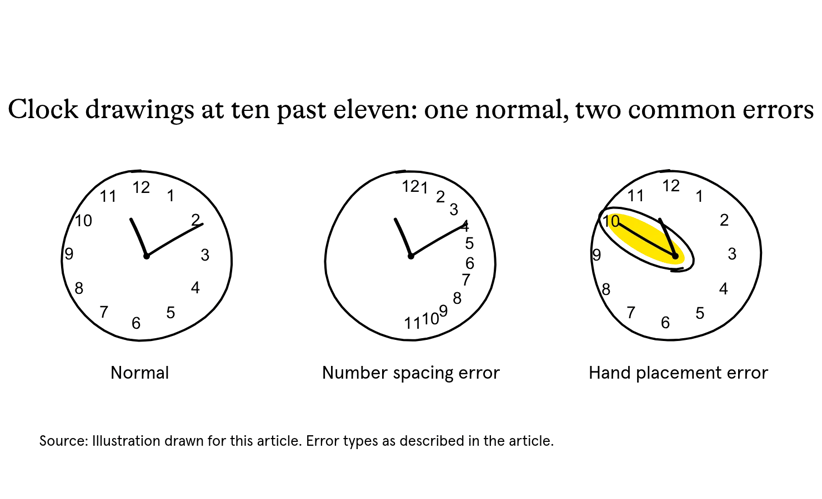
Clock-drawing test scoring
|
System |
Year |
Scale |
What it scores |
|---|---|---|---|
|
Shulman |
1986 |
0 to 5 |
Overall representation of the clock and the severity of errors |
|
Sunderland |
1989 |
1 to 10 |
Specific errors in the numbers and hands, scored in detail |
|
Mini-Cog Clock Drawing Component |
2000 |
0 or 2 |
Whether the clock is drawn correctly, alongside three-word recall |
|
Others, including Mendez and Tuokko |
1992 onward |
Varies |
More than a dozen systems exist, with similar psychometric properties |
All of them depend on the scorer's judgment about what counts as an error.
What the clock drawing test measures
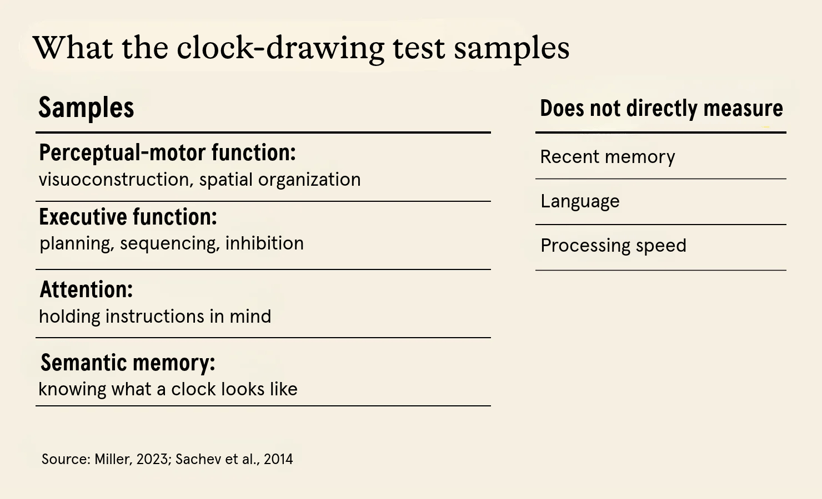
Clock drawing engages multiple cognitive processes, including visuospatial and visuoconstructional abilities, executive functioning, attention, and semantic knowledge. However, performance reflects the combined contribution of these abilities rather than providing independent measurements of each domain.
Perceptual-motor function
Involves visuoconstruction and spatial organization. This sample looks like placing 12 numbers evenly around a circle.
Executive function
Evaluates planning and sequencing. An example of this may be inhibiting the urge to put a hand on the 10 when asked for ten past eleven.
Attention
Assesses the ability to hold the instructions in mind while working through the drawing.
Semantic memory
Involves the general knowledge of what a clock looks like.
The test does not directly measure recent memory, which is why the Mini-Cog pairs it with a three-word recall task. It also leaves out language and processing speed.
Clock drawing test interpretation: what a result can and cannot tell you
Reviews have reported sensitivity and specificity estimates approaching 85% for dementia detection, although performance varies considerably depending on the scoring system, study population, and diagnostic reference standard. Inter-rater and test-retest reliability also depend on the scoring approach used [1]. In a 2022 meta-analysis, pooled estimates for paper clock drawing in dementia were slightly lower, at 80 to 83% sensitivity and 80 to 81% specificity [5].
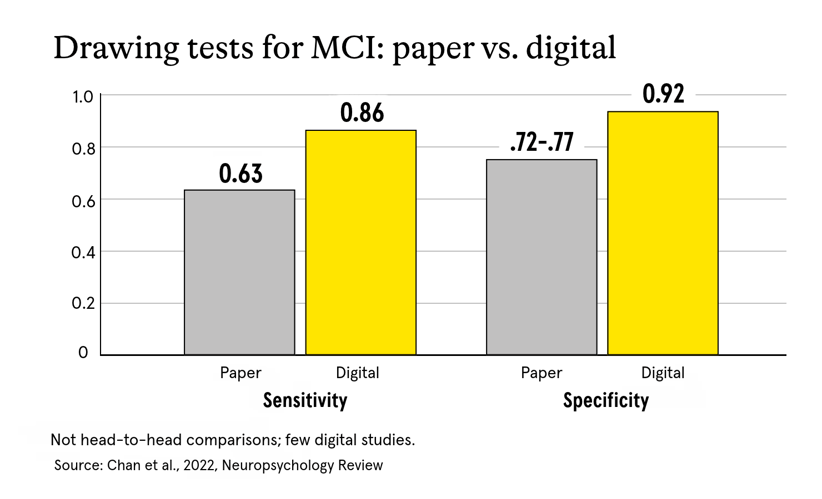
Results are less encouraging for mild impairment. In a 2022 meta-analysis, paper clock-drawing tests had a sensitivity of 0.63 for MCI, meaning they missed more than a third of cases [5]. Specificity also varies in MCI and early dementia [1]. The US Preventive Services Task Force reported a similar pattern across brief tools, which were generally less accurate for MCI than for dementia [6].
This matters because a normal clock drawing does not rule out impairment. MCI is the stage at which early evaluation is most useful, and it is the stage a standalone clock misses most often. A clinician who takes a normal clock as reassurance may send a patient home at the point when a closer look would help most.
Other factors can lower a score without any cognitive impairment, including motor or vision problems, fewer years of schooling, unfamiliarity with analog clocks, and differences between scorers. An abnormal clock therefore calls for further evaluation before any conclusion is drawn.
The table below summarizes how paper and digital clock drawing performed in the 2022 meta-analysis [5].
|
Setting |
Paper clock drawing |
Digital clock drawing |
Comparison |
Source |
|---|---|---|---|---|
|
Dementia |
Sensitivity 80 to 83%, Specificity 80 to 81% |
Sensitivity 83%, Specificity 87% |
Comparable (no significant difference; P = 0.33 brief, P = 0.35 detailed) |
Chan, 2022 [5] |
|
Mild cognitive impairment |
Sensitivity 63%, Specificity 72 to 77% |
Sensitivity 86%, Specificity 92% |
Digital significantly better (P = 0.02 brief, P < 0.001 detailed) |
Chan, 2022 [5] |
Digital clock drawing: what changes and what does not
Tablet versions of the test record how the clock is drawn as well as what is drawn, including drawing time, pressure, velocity, acceleration, and time with the pen lifted. In the 2022 meta-analysis, digital clock drawing tests reached a sensitivity of 0.86 and a specificity of 0.92 for MCI, based on four studies [5]. The authors note that these were not head-to-head comparisons with paper and that few digital studies were available.
The extra data can reveal what a finished drawing hides. A clock that looks normal may have taken a long time to complete, with long pauses before each number. Paper scoring sees only the result, while a digital recording also captures the process.
The task itself stays the same. A digital clock is still a single task that samples the same domains and produces one result. Digitizing it makes scoring more consistent without widening what the test measures.
Why a single task is a starting point, not a profile
The clock drawing is a single task. It draws on the domains described above, and the result reflects how a person performed on that one activity. For many purposes, that is enough: the test gives a quick first look. Its limits appear when a clinician needs finer detail, as in the earlier stages of impairment, where one task has little to go on. A screener made up of several standardized tasks, each sampling different domains, can show where a person performs well and where they struggle. Comparing performance across those domains gives the clinician a profile that points toward what to evaluate next.
BrainCheck is one digital platform that provides multi-task and multi-domain screening. Its tools utilize standardized tasks across various cognitive domains and can be administered both digitally in a clinical setting or remotely. Additionally, BrainCheck offers screeners that cater to individuals with motor impairments, as well as those with limited literacy or less comfort using technology.
%20Email%20images/Mary%20Patterson%20-%20Headshot.png?width=150&height=150&name=Mary%20Patterson%20-%20Headshot.png) Written by Mary Patterson, M.S.
VP of Clinical & Regulatory at BrainCheck
Mary Patterson is a clinical and operational leader with more than a decade of experience advancing medical technologies through clinical research and regulatory strategy. Her expertise spans neuroscience, Alzheimer’s disease, and neurovascular research, with a focus on translating evidence-based science into regulated, real-world medical products.
How we wrote this: We used AI tools to help research and draft this article. Mary Patterson, VP of Clinical & Regulatory at BrainCheck, reviewed it for clinical accuracy, and our editors checked every reference against its source. Read our AI policy for content.
Q&A: The clock drawing test
What does the clock drawing test measure?
Visuoconstruction, spatial planning, executive function, attention, and semantic memory. It does not directly measure recent memory, language, or processing speed.
How is the clock drawing test scored?
More than a dozen systems exist. Shulman's uses a scale of 0 to 5, Sunderland's 1 to 10, and the Mini-Cog rates the clock as normal or abnormal. Brief and detailed systems perform similarly for MCI [5].
Is the clock drawing test accurate for dementia?
Reviews report mean sensitivity and specificity of about 85% for dementia, with good agreement between scorers [1]. A review of 12 studies concluded that the test appears to be a good screening test for dementia, although results across studies were mixed [2].
Can the clock drawing test detect mild cognitive impairment?
Not reliably on its own. A 2022 meta-analysis found sensitivity of 0.63 for MCI in paper versions [5], and reviews describe lower sensitivity in early impairment [1].
What time is used in the clock drawing test?
Most protocols use ten past eleven. Setting it requires the person to resist placing a hand on the 10 and to plan two hands of different lengths.
Is a digital clock drawing test better?
Digital clock-drawing tests can capture additional performance metrics, such as drawing time and stroke dynamics, that are not routinely available through traditional paper scoring. Some studies have reported improved sensitivity for MCI, but available evidence is limited and does not establish that digital approaches are universally superior.
References
-
Miller. (2023). The Clock-Drawing Test. Psychiatric Times. https://www.psychiatrictimes.com/view/the-clock-drawing-test
-
Aprahamian, I., Martinelli, J. E., Neri, A. L., & Yassuda, M. S. (2009). The clock drawing test: A review of its accuracy in screening for dementia. Dementia & Neuropsychologia, 3(2), 74-81. http://www.scielo.br/j/dn/a/7pHCwDkLK8jDbKy7wnjFYSL/?lang=en
-
Borson, S., Scanlan, J., Brush, M., Vitaliano, P., & Dokmak, A. (2000). The Mini-Cog: A cognitive 'vital signs' measure for dementia screening in multi-lingual elderly. International Journal of Geriatric Psychiatry, 15(11), 1021-1027. https://pubmed.ncbi.nlm.nih.gov/11113982/
-
Nasreddine, Z. S., Phillips, N. A., Bédirian, V., et al. (2005). The Montreal Cognitive Assessment, MoCA: A brief screening tool for mild cognitive impairment. Journal of the American Geriatrics Society, 53(4), 695-699. https://pubmed.ncbi.nlm.nih.gov/15817019/
-
Chan, J. Y. C., Bat, B. K. K., Wong, A., et al. (2022). Evaluation of digital drawing tests and paper-and-pencil drawing tests for the screening of mild cognitive impairment and dementia: A systematic review and meta-analysis of diagnostic studies. Neuropsychology Review, 32(3), 566-576. https://link.springer.com/article/10.1007/s11065-021-09523-2
-
US Preventive Services Task Force. (2020). Cognitive impairment in older adults: Screening. Final recommendation statement. https://www.uspreventiveservicestaskforce.org/uspstf/recommendation/cognitive-impairment-in-older-adults-screening