
What It Does
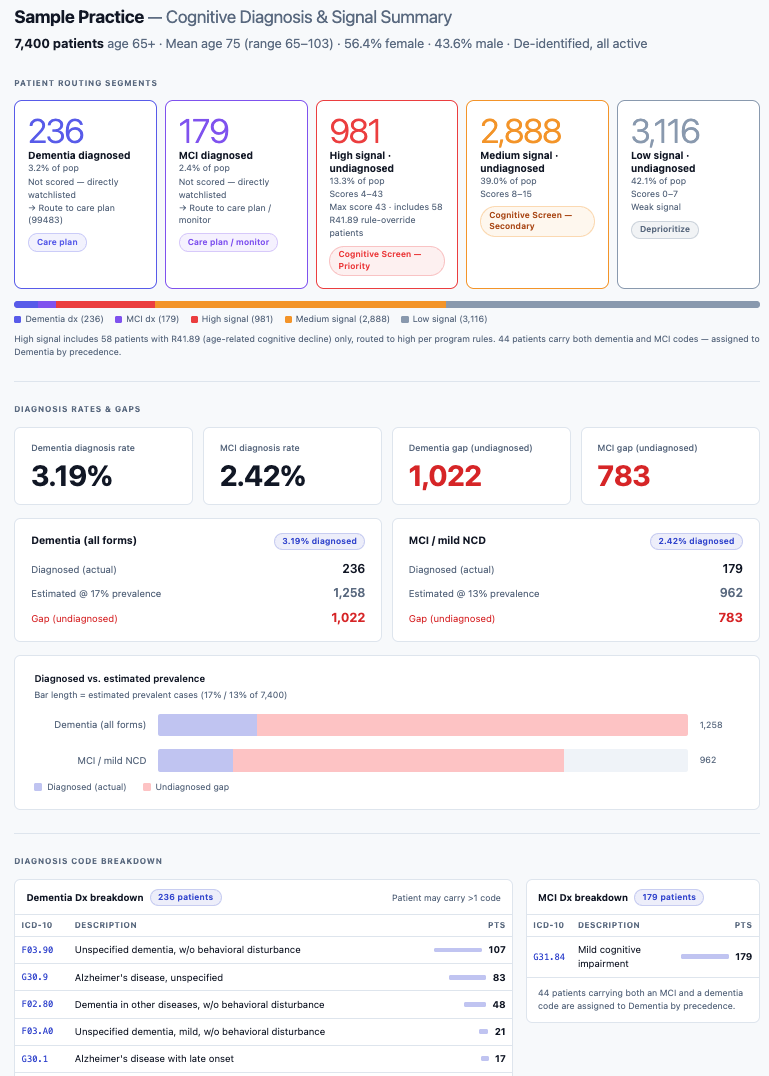
BrainCheck Population Analytics analyzes your existing EHR data and sorts your population into three groups:
- Diagnosed: Patients with a documented dementia diagnosis on file
- Elevated Signal: Patients whose records show data patterns associated with elevated cognitive signals
- Moderate Signal: Patients whose records show patterns associated with moderate signals
Each prioritized patient record includes the structured EHR data elements and research-derived analytic criteria supporting its inclusion, enabling clinicians to independently evaluate the basis for prioritization. The registry organizes information for review to provide a starting point, not a verdict.
Organizations Receive
-
Executive Population Analytics Dashboard
-
Prioritized patient registry
-
Secure patient outreach file
-
Biomarker opportunity analysis
-
Executive summary of findings
-
Executive clinical review
Grounded in Published Research
Built on published research analyzing over 153 million patient records across two independent datasets, identifying reproducible phenotypes that precede an Alzheimer's diagnosis.
Paired with a second externally validated methodology, eRADAR, shown in published research to identify previously undiagnosed dementia in large real-world health systems.
The result: a registry grounded in documented, peer-reviewed patterns, not guesswork.
BrainCheck does not diagnose. The assessment surfaces patterns for your team's review.
Your questions, answered.
Key things to know and discover about BrainCheck Population Analytics.
For additional FAQs, click here.
No. BrainCheck does not diagnose any condition. The assessment identifies research-derived data patterns present within structured EHR records to surface patients who may warrant a closer look. All evaluation, assessment, and diagnostic decisions remain with your clinicians.
No. Most clients start with a de-identified extract. BrainCheck returns a signal-based list, and your team re-identifies and coordinates outreach internally. A direct workflow is available for clients who prefer it.
We recommend the last 24 months of encounter and diagnosis history, with 12 months as a minimum.
Standard flags typically rely on one or two data points. Our model draws on a much wider set of clinical markers, developed from published research spanning millions of patient records, to produce a signal-based, population-wide view rather than a single alert. The output is a prioritization tool for your team, not a diagnostic tool.
Yes. Each prioritized patient record includes the structured EHR data elements and research-derived analytic criteria that contributed to its inclusion. The registry is intended solely to organize information for clinician review and does not indicate that a patient has, is likely to have, or will develop any medical condition. Clinicians independently evaluate the underlying information before determining whether additional evaluation or follow-up is appropriate.

Did you know?
Playing chess can enhance problem-solving skills and improve memory, helping the brain maintain its cognitive sharpness.