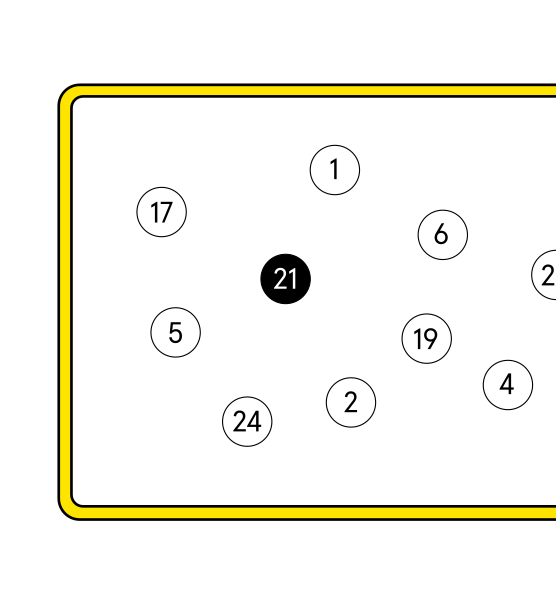

One Platform for Cognitive Care
BrainCheck supports configurable, longitudinal cognitive care across clinical and research settings. The BrainCheck Platform includes more than 20 screeners, with BrainCheck Assess serving as the FDA Class II flagship assessment.
Trusted by Leading Neurologists, Psychiatrists, Primary Care Providers, and Clinical Researchers
Cleveland Clinic • Stanford University • MD Anderson Cancer Center • Mount Sinai • UPMC • University of Texas at Austin • UTHealth Houston • University of Colorado Anschutz Medical Campus • Springfield Clinic • Dent Neurologic Institute
See what our customers are saying
“Before using BrainCheck, we used traditional pencil-and-paper tests and we found these difficult to use as they were very subjective. Using BrainCheck was a perfect solution to elevate our clinical insights and helps us provide better patient care.”
“BrainCheck has streamlined our cognitive care process, from rapid screenings to in-depth assessments and empathetic care planning, offering a modern solution with clear benefits.”
“With BrainCheck Screen, we can accurately and efficiently check cognitive health, allowing us to easily comply with Medicare requirements to assess cognitive function during annual wellness visits. It helps us rapidly determine which patients require additional testing and enhances our patient care.”
“We owe it to our patients to shed light on a cognitive issue that could become problematic as soon as possible, and BrainCheck can help physicians achieve this quickly and easily.”
“BrainCheck’s technology is essential for providers to meet the GUIDE Model’s required core elements. From thorough assessments to personalized care plans, BrainCheck equips healthcare professionals to address the unique needs of each patient and care partner effectively.”
A Platform Built Around a Clinically Validated Assessment
BrainCheck AssessTM
Detect subtle signs of cognitive impairment, which may have association with dementias, including Alzheimer's disease.
BrainCheck Assess is the platform’s flagship product and the only FDA Class II cleared component. It operates within the BrainCheck Platform and can be used on its own or combined with more than 20 validated cognitive screeners and care planning tools.
Published research shows that BrainCheck Assess scores correlate highly with the Montreal Cognitive Assessment (MoCA) (correlation coefficient 0.77). Peer-reviewed studies also demonstrate the ability of the assessment battery to distinguish between normal cognition, mild cognitive impairment, and dementia with high sensitivity and specificity. These findings support the clinical validity of BrainCheck Assess as an objective digital cognitive assessment used across care settings.
We Exist to Help Close the Cognitive Care Gap
17%
Mild Cognitive Impairment
About 17 percent of adults age 65 and older have mild cognitive impairment, according to a review published by the National Library of Medicine.
13%
Dementia
About 13 percent of adults age 65 and older have dementia, based on Alzheimer’s Association prevalence for Alzheimer’s disease and National Library of Medicine findings.
We're Closing the Gap
Despite these prevalence estimates, Medicare claims data show substantially lower rates of documented cognitive diagnoses, particularly for mild cognitive impairment.
Millions of older adults may have cognitive impairment that has not yet been clinically identified or formally documented, contributing to delayed care and missed interventions.
All clinical diagnoses are made based on individual medical necessity and clinician judgment. Population prevalence estimates are not diagnostic and do not imply that any individual patient should receive a diagnosis.
The Cognitive Care Continuum
A single platform designed to enable cognitive care over time:
- Screening
- Assessment
- Interpretation
- Care Planning
- Follow-up
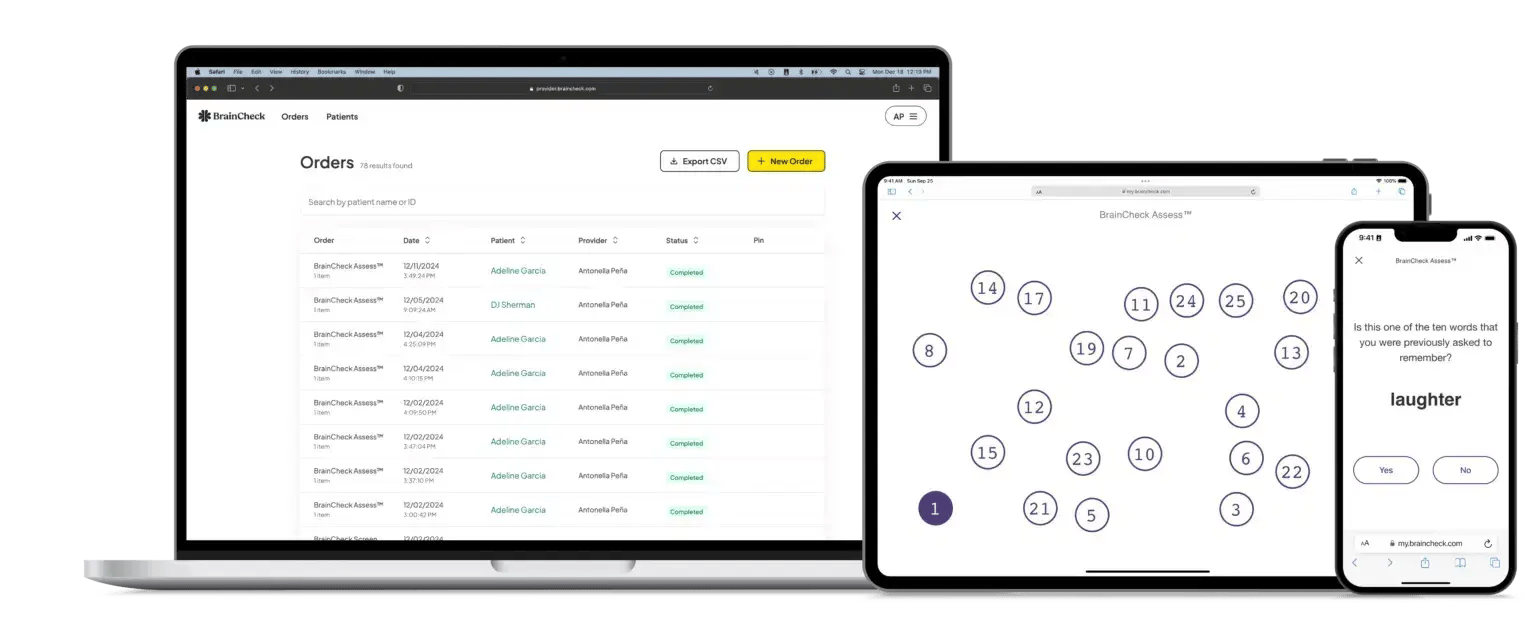
Built to Integrate Into Clinical Workflows
BrainCheck supports workflow integration with commonly used electronic health record systems, allowing cognitive screening, assessment, and follow-up to occur within routine care.
Epic • athenahealth

Continuously Improving, Backed by Real-World Data
BrainCheck releases new product features approximately every two weeks. The platform is supported by a normative database of more than 5,000 patients and a real-world dataset of more than 450,000 patient assessments.

Built and Supported in Austin, TX, and New York City
BrainCheck is headquartered in Austin, Texas, with an office in New York City and provides live United States-based clinical and technical support. Support is available for product use, documentation, and billing-related questions.

Ongoing Clinical Research and Academic Partnerships
BrainCheck continues to invest in clinical research and collaborates with leading academic and research institutions, including the University of Texas at Austin, University of Michigan, University of Melbourne, UTHealth Houston, Mount Sinai, MD Anderson Cancer Center, Stanford University, Johns Hopkins University, Baylor College of Medicine, and CHU Sainte-Justine Research Center.
Ready to get started?
A new, more accessible journey towards empowered and informed brain health awaits.
Latest news and insights
Get more cognitive health insights delivered to your inbox
References
- BrainCheck Screen Validation. (2023). Accessible via BrainCheck.com.
- Ye S, Sun K, Huynh D, Phi HQ, Ko B, Huang B, Hosseini Ghomi R. A Computerized Cognitive Test Battery for Detection of Dementia and Mild Cognitive Impairment: Instrument Validation Study. JMIR Aging 2022;5(2):e36825 doi: 10.2196/36825
- Groppell S, Soto-Ruiz KM, Flores B, Dawkins W, Smith I, Eagleman DM, Katz Y. A Rapid, Mobile Neurocognitive Screening Test to Aid in Identifying Cognitive Impairment and Dementia (BrainCheck): Cohort Study JMIR Aging 2019;2(1):e12615. https://doi.org/10.2196/12615
- 2024 Alzheimer’s disease facts and figures. Alzheimers Dement. 2024 May;20(5):3708-3821. doi: 10.1002/alz.13809. Epub 2024 Apr 30. PMID: 38689398; PMCID: PMC11095490.
- Soeren Mattke et al, Expected and diagnosed rates of mild cognitive impairment and dementia in the U.S. Medicare population: observational analysis, Alzheimer’s Research & Therapy (2023). DOI: 10.1186/s13195-023-01272-z
- Livingston G, Huntley J, Sommerlad A, et al. Dementia prevention, intervention, and care: 2020 report of the Lancet Commission. Lancet. 2020;396(10248):413–446. https://doi.org/10.1016/S0140-6736(20)30367-6
- Huynh D, Sun K, Hosseini Ghomi R, Huang B. Comparing psychometric characteristics of a computerized cognitive test (BrainCheck Assess) against the Montreal cognitive assessment. Front Psychology (2024). https://doi.org/10.3389/fpsyg.2024.1428560
Some feature availability determined by EHR integration.
Did you know?
Listening to music stimulates more areas of the brain than almost any other activity.